Mostrando entradas con la etiqueta kanban. Mostrar todas las entradas

viernes, 27 de octubre de 2023

Logistionary: Kanban


Kanban is a visual scheduling system for lean manufacturing.

It all started in the early 1940s when the first Kanban system was developed by Taiichi Ohno for Toyota automotive in Japan. It was created as a simple planning system, the aim of which was to control and manage work and inventory at every stage of production optimally.

The Kanban method gets its name from the use of kanban, visual signalling mechanisms to control work in progress for intangible work products.

Kanban aligns inventory levels with actual consumption. A signal tells a supplier to produce and deliver a new shipment when a material is consumed. This signal is tracked through the replenishment cycle, bringing visibility to the supplier, consumer, and buyer.

In contexts where supply time is lengthy and demand is difficult to forecast, often the best one can do is to respond quickly to observed demand. This situation is exactly what a kanban system accomplishes, in that it is used as a demand signal that immediately travels through the supply chain.

Kanban cards are a key component of kanban, and they signal the need to move materials within a production facility or to move materials from an outside supplier into the production facility. The kanban card is, in effect, a message that signals a depletion of product, parts, or inventory. When received, the kanban triggers replenishment of that product, part, or inventory.

Three-bin system

An example of a simple kanban system implementation is a "three-bin system" for the supplied parts, where there is no in-house manufacturing. One bin is on the factory floor (the initial demand point), one bin is in the factory store (the inventory control point), and one bin is at the supplier. The bins usually have a removable card containing the product details and other relevant information, the classic kanban card.

When the bin on the factory floor is empty (because the parts in it were used up in a manufacturing process), the empty bin and its kanban card are returned to the factory store (the inventory control point). The factory store replaces the empty bin on the factory floor with the full bin from the factory store, which also contains a kanban card. The factory store sends the empty bin with its kanban card to the supplier. The supplier's full product bin, with its kanban card, is delivered to the factory store; the supplier keeps the empty bin. This is the final step in the process. Thus, the process never runs out of product, and could be described as a closed loop, in that it provides the exact amount required, with only one spare bin so there is never oversupply.

If all this is confusing, and you´re still not clear on how Kanban works, Im sure the next image will make everything fall into place! One image is indeed worth a thousand words as they say!


lunes, 15 de mayo de 2023

Hoshin Kanri: translating strategic plans into actionable items


Many companies struggle with translating strategic plans into actionable items on a daily process, luckily, among the most powerful tools in the Lean arsenal for effective strategic management we can find Hoshin Kanri.

Similar Jidoka or Just in Time, Hoshin Kanri has its roots in the Toyota Production System and as a tool, it can be very helpful, when implemented properly, in bridging the gap between strategy and execution.

Hoshin Kanri has a Matrix shape with four quadrants each devoted to a specific task.

1-     Set the strategic vision & goals (3-5 year breakthrough objectives):


The long-term goals is the starting point In Hoshin Kanri, normally in the frame between 3 and 5 years.


List them at the bottom quadrant of the matrix template and have in mind that every initiative will have many smaller tasks that will need to process before achieving the goal.


2-     Define key mid-term objectives (annual objectives)


After your long-term goals are all set, prepare the most important objectives that you aim to achieve in a shorter time frame and put them in the left quadrant of the Hoshin matrix.


3-     Set short-term actions and metrics (improvement priorities)


You will need to fill the top quadrant with the most important activities that need to be completed to achieve the short-term goals, this is basically the to-do list for the upcoming months.


4-     Agree on key performance indicators (targets to improve)


Agree on the most crucial metrics that need to be improved and list them on the diagram.


Following this line of thought, right next to the key metrics, you need to list the key stakeholders responsible for leading the completion of the activities in the matrix's top quadrant.


Finally, you should complete the picture by specifying the dependencies between every listing in your matrix.


domingo, 9 de mayo de 2021

Agile methodology


If you have been following this blog for a while, you would know that we have already shared some insights on the world of project management methodologies that you can find below:


Project Management: Waterfall VS Agile

Agile methodology: Kanban VS Scrum


Today we will get another step closer into understanding what Agile methodologies are and what are the differences as well as the similarities among the different options. 

We will also discover, what are the benefits of these methodologies and when we should apply them.

Hope you enjoy the video!


Agile methodologies


domingo, 7 de julio de 2019

Agile methodology: Kanban VS Scrum


After a very comprehensive intro on Project Management methodologies where we explored Agile VS Waterfall, in today's post we are going to deep dive on some of the differences between Kanban and Scrum, two of the frameworks within the Agile framework.

While there are some clear differences between both practices, the principles are largely the same.

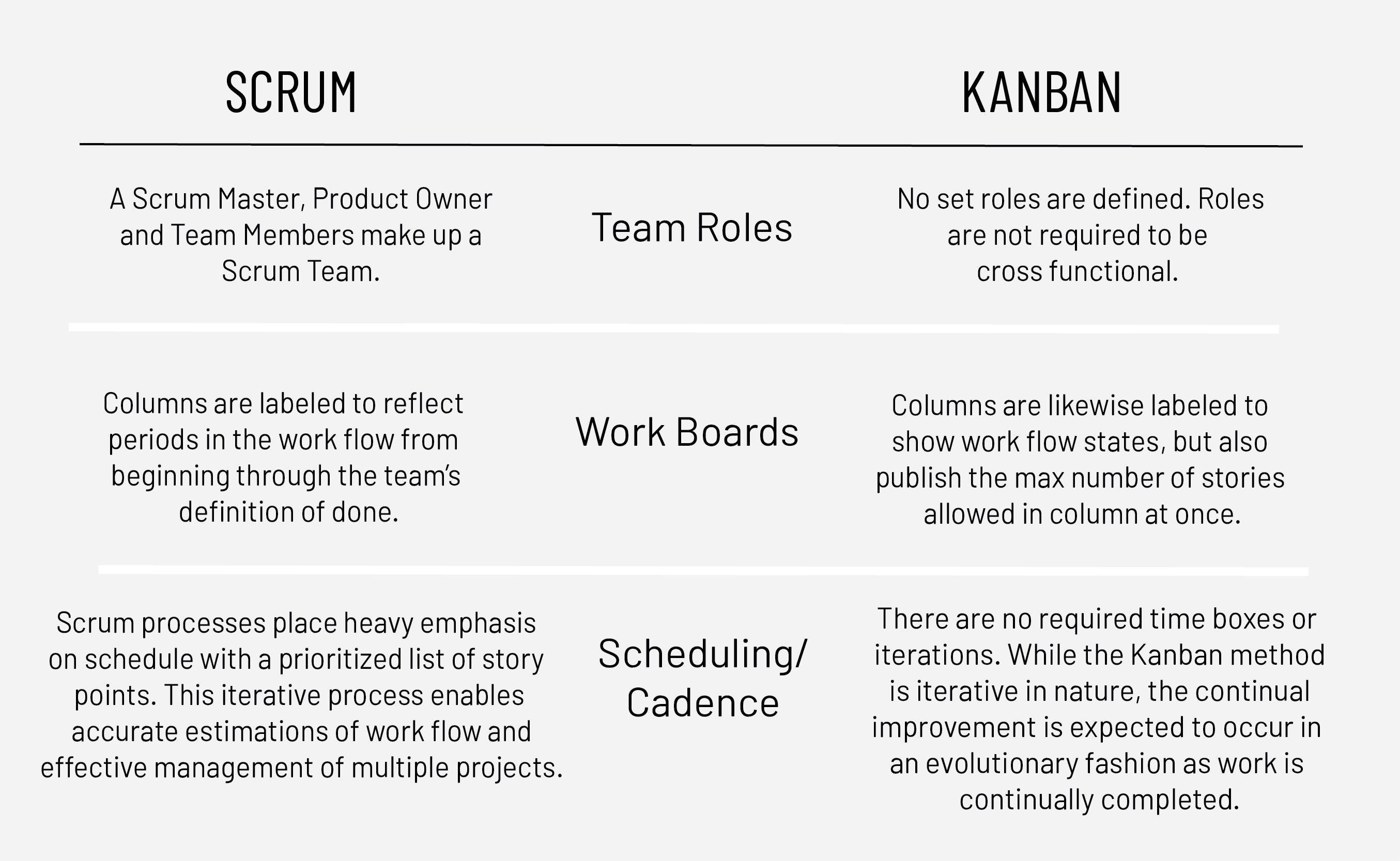
Scrum is a tool used to organise work into small, manageable pieces that can be completed by a cross-functional team within a prescribed time period called a “sprint” (generally 2-4 weeks long). To plan, organise, administer, and optimise this process, Scrum relies on at least three prescribed roles: 

-  The Product Owner, responsible for initial planning, prioritising, and communication with the rest of the company

- The Scrum Master, responsible for overseeing the process during each sprint.

- The Team Members, responsible to carry out the purpose of each sprint, such as producing software code.

Kanban is also a tool used to organise work for the sake of efficiency, and like Scrum, Kanban encourages work to be broken down into manageable chunks, however, where Scrum limits the amount of time allowed to accomplish a particular amount of work, by means of sprints, Kanban limits the amount of work allowed in any one condition as only so many tasks can be ongoing.

 In the table below you can find the main differences between Scrum and Kanban:


Finally the video below illustrates very clearly the differences and points out how the Scrum and Kanban boards work.


Until next time!


domingo, 10 de septiembre de 2017

Just in time

Just-in-time manufacturing (JIT) also known as the Toyota Production System is a methodology aimed at reducing flow times within production systems as well as response times from suppliers and to customers.

It originated in Japan in the 1960s and 1970s, but the wise use of the term JIT faded in the 1990s as the new term “lean manufacturing” was established as a more recent name for JIT.

Benefits:

- Lower warehouse costs. Since less space is needed, this reduces the amount of storage an organisation needs to buy or rent.

- Less amount of inventory obsolescence, when companies use the traditional method of inventory they can end up with pallets of unsold items that simply go to waste

- Defect rates are reduced resulting in less waste and greater customer satisfaction.


Risks:


- You become reliant on your suppliers. Suppliers need to be able to supply materials quickly with very limited advance notice and any unexpected even can derive in long term out of stocks.

- Employees are at risk of precarious work as employers seek to easily adjust their workforce in response to supply and demand conditions by increasing the amount of contracting and temporary work.

- By not carrying much of stock, the risk of out of stocks is higher making imperative to have the correct procedures in place to ensure stock can become readily available.

- More and better planning is required to ensure stock is available at all times

If you want to learn more, check out the video below that explains in detail what JIT is and all the elements around this philosophy. 


Couldn´t finish this post without some music. Happy week!