Mostrando entradas con la etiqueta 5s. Mostrar todas las entradas

lunes, 30 de junio de 2025

Logistionary: Genchi Genbutsu


Genchi Genbutsu is a core principle of the Toyota Production System that translates to "go and see for yourself."

It emphasizes firsthand observation to understand situations deeply, solve problems accurately, and make informed decisions.

Instead of relying on second hand reports or data alone, leaders and team members are encouraged to go to the actual place where value is created, such as the factory floor, the customer site, or the development environment.

The Genchi Genbutsu approach involves:

  • Visiting the gemba: Physically going to the site of the issue or process.
  • Observing without assumptions: Understanding the facts directly through observation.
  • Engaging with people: Talking to employees, operators, or customers involved.
  • Asking “Why?” and using the “5 Whys” technique to get to the root cause.
 
Genchi Genbutsu promotes situational awareness, empathy, and fact-based leadership. It bridges the gap between strategy and execution, ensuring leaders stay grounded in operational realities.

Finally, a word to clarify the difference between Genchi Genbutsu and Gemba; Gemba means "the real place" where work happens and value is created (like a factory floor) Genchi Genbutsu means "go and see for yourself" and emphasizes firsthand observation to understand problems deeply.

Gemba is the location, Genchi Genbutsu is the mindset and method of investigation.


jueves, 3 de agosto de 2023

Logistionary: Kano model


The Kano model is a theory for product development and customer satisfaction developed in the 1980s by Noriaki Kano, a professor of quality management at the Tokyo University of Science.

It´s an approach to prioritizing features on a product roadmap based on the degree to which they are likely to satisfy customers. Product teams can weigh a high-satisfaction feature against its costs to implement to determine whether or not adding it to the roadmap is a strategically sound decision.

The model involves two dimensions:

1. Achievement (the horizontal axis), which goes from the supplier didn’t do it at all to the supplier did it very well.

2. Satisfaction (the vertical axis), which goes from total dissatisfaction with the product or service to total satisfaction with the product or service.

It also identifies three levels of customer expectations: that is, what it takes to positively impact customer satisfaction

1. Expected needs: These are the must haves, the requirements that the customers expect and are taken for granted.

These expectations are also known as the dissatisfiers because by themselves they cannot fully satisfy a customer. However, failure to provide these basic expectations will cause dissatisfaction.

Examples: In a hotel, providing a clean room is a basic necessity. In a call center, greeting customers is a basic necessity.

2. Normal needs: These are known as the wants or the satisfiers because they are the ones that customers will specify from a list. They can either satisfy or dissatisfy the customer depending on their presence or absence.

Examples: Time taken to resolve a customer's issue in a call center. Waiting service at a hotel.

3. Exciting needs: These are features and properties that make a supplier a leader in the market. These are the delighters or exciters because they go well beyond anything the customer might imagine and ask for. Their absence does not dissatisfy the customer, but their presence improves the likelihood of purchase.

Examples: In a callcenter, providing special offers and compensations to customers or the proactive escalation and instant resolution of their issue is an attractive feature. In a hotel, providing free food is an attractive feature.

How Does the Kano Model Work?

Using the Kano Model, product teams pull together a list of potential new features vying for development resources and space on the roadmap. The team will then weigh these features according to the two competing criteria:

1. Their potential to satisfy customers.

2. The investment is needed to implement them.


jueves, 11 de noviembre de 2021

Gemba walk


Another term coined in Japan, Gemba means "the actual place", and in operations specifically Gemba usually refers to the shop floor or where the service provider interacts directly with the customer.


This concept was popularised thank to the lean manufacturing methodology, with the idea that problems are mostly visible when going to the “Gemba”, and the best improvement ideas will come from spending time where the actual issue is.


In practical terms it means that whenever there is a problem, senior management and they key decision makers must go to where the problem is to understand its full impact, gathering data from all sources.


Only when the problem has been studied “in situ” the team can go away and start working on a solution.


This concept that may seem trivial and common sense is most times undervalued and decisions to problems are being drafted and executed from the head office and regardless of the specific constraints affecting the shop floor.


You cannot expect different results by sitting in your corner office and only attending KPI meetings., instead, you need to see where the real work happens. You need to do Gemba walks.


The Gemba walk, denote the action of going to see the actual process, understand the work, ask questions, and learn, and is an activity that takes staff to the front lines to look for opportunities and practical shop floor improvement.

There are 3 important elements of this lean manufacturing tool:


1.  Go and see. Take regular walks around the shop floor and be involved in finding wasteful activities.

     2. Ask why. The main objective of a Gemba walk is to explore the value stream in detail and locate its problematic parts through active communication.

     3. Respect people. Keep in mind that a Gemba walk is not a “boss walk” or a pointing fingers exercise. You are not there to judge you are there to collaborate with the team and find problems together.


There are 7 suggested steps to follow when you go to a Gemba walk:


1. Pick a theme. This will help you focus all your efforts and be effective. There are different themes you may want to explore, such as productivity, cost efficiency, safety and etc. In order to be as precise as possible, you will also need to prepare a list of questions you are going to ask.


2. Prepare your team. The team that will be observed should be prepared for what is going to happen and have a clear understanding that the Gemba walk is a common process where the final destination is continuous improvement and not an opportunity to excrutinise their job competencies.


3. Linked to the above, focus on the process, not on people. You need to remember that the main purpose is to observe, understand, and improve the process not to evaluate your teams performance.


4. Be where the value stream is. Following the value chain will give you the best opportunities to identify areas with a high potential for waste activities.


5. Record your observations. Write down everything that grabs your attention. In some cases, you will probably be tempted to offer a solution immediately, but this would be wrong. Leave the analysis for later. You will be much more precise after you have all the facts available.


6. An extra pair of eyes. It may be a good idea to invite a colleague from another department. Someone with totally different daily tasks. People who are less familiar with the processes usually have a fresh perspective and ask different questions that you may never ask.


7. Follow-up. Even if you don’t find anything significant during your Gemba walk, you need to share with the team what you have learned or seen. Otherwise, the team will only have the feeling of being watched. If you are going to take action after the walk, inform the team about the upcoming changes and why they are necessary.

As important as the Gemba walk itself it the post-walk analysis to close the loop. Before you take any actions based on your observations, you will need some time to organize your thoughts and notes.


Conduct a meeting after each Gemba walk that may include participants from different departments. The main purpose is to have as many different points of view as possible to make the best decision.


domingo, 20 de octubre de 2019

Continuous improvement - Improve 1% every day


The marginal gains philosophy is really easy to understand; it comes down to the idea that, if you just improve 1% each day, you're going to accumulate some pretty hefty results for minimal perceived effort.

However, who can get excited about a 1% daily improvement? Well, think that over a year, those daily 1% improvements will have stacked up to give a total improvement of over 3,700%!
Improving 1% each day can yield some BIG dividends, and the best example of that is probably the GB cycling Olympic team in London 2012 with Chris Brailsford at the helm.
The whole principle came from the idea that if you break down everything you could think of that goes into riding a bike, and then improved it by 1%, you will get a significant increase when you put them all together
No stone was left unturned; they even paid attention to things like always washing your hands thoroughly to help avoid getting sick or taking your own pillow when you travel so you're better rested.
Thanks to this "aggregation of marginal gains" the British cycling team dominated the competition.
However, this isn't just about professional athletes, the basic idea of accumulating small increments of progress can work for everything.
Healthcare, aviation, learning and even speed eating have benefited in the past by this philosophy, so…what can you do right now to improve by just 1%?

miércoles, 9 de diciembre de 2015

Logistionary: Jidoka


Logistionary is back with new terms, definitions and concepts! And today it’s the turn for Jidoka.
For those of you that are familiarised with this term, there is still a lot to learn from this entry, for those that have never heard of Jidoka, watch out for what is one of the most important terms within the lean manufacturing environment.
First off, what is Jidoka, and why most of these terms have Japanese names?
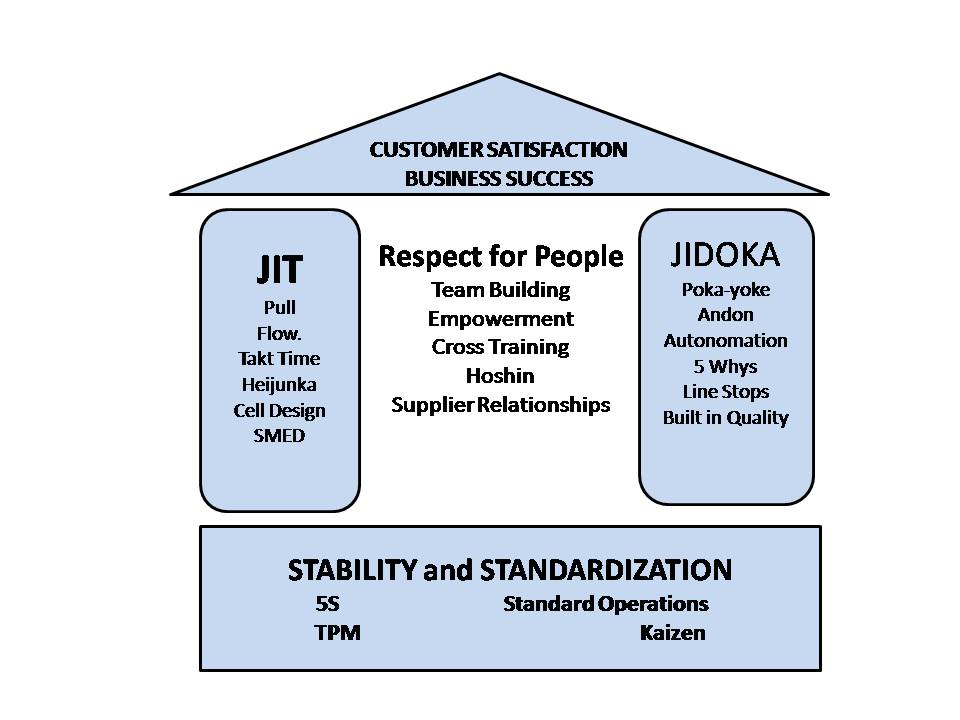
Jidoka is the often forgotten pillar of the Toyota Production system but yet one of the most important, and the one that actually was a breakthrough in terms of achieving true excellence in manufacture.

Now, why most of these terms have Japanese names? Well, because they all actually were coined by the same person, Sakichi Toyoda, the founder of Toyota Industries, and the person that revolutionised the rudimentary logistic processes of that time. 


Coming back to the term that concerns us; Jidoka began with the invention of a simple device that could stop the shuttle on an automatic loom should the thread broke. This will prevent the machine from not only creating defects but also alerted the operator of a problem. This meant that now the operator could operate several machines at the same time and not only focus on just one in case something went wrong. This principle became known as “automation with a human touch”


Jidoka is based in 4 very simple principles:
  1. Discover an abnormality
  2. Stop
  3. Fix the immediate problem
  4. Investigate the root cause and correct


These principles are not just confined to use of machines, but they are visible in almost every aspect of lean manufacturing. It’s about building quality into a process rather than having to inspect the outcome at the end of the process.
Every individual in a lean company is allowed and actually is expected to stop the process should they discover an abnormality, this way problems are highlighted and actions to solve them are taken. This is a concept many western companies find hard to implement as they fear a loss in productivity derived from lines being constantly stopped. This fear however undermines the core principle of Jidoka which is investigating the root causes of problems and working on tackling them.
Even though stopping the lines might seem contra intuitive, in the long term the number of line stops begins to reduce as problems are removed and productivity begins to improve as root causes of problems are removed.
Within companies such as Toyota line stop is a way of life, if an operator detects a problem they pull a cord or push a button to stop the production line at the end of that production cycle. This alerts the team leader or supervisor who will immediately rush over to help solve the problem. If it can be easily corrected then they do so and restart the line, otherwise they call in whatever support is required to solve the problem.
The major obstacle to implement Jidoka and any other lean principles is the fear of the short term implications when stopping the lines, but once this concerns are overcame Jidoka has proven to be a major advantage in adding value and increasing productivity across all lines.
I hope you enjoyed this entry and you learnt something new. Watch this space for more interesting concepts in the near future!


lunes, 28 de enero de 2013

5S


In today´s post I would like to explore the so called 5S in logistics. 

The 5S is one of the most popular methodologies organizations adopted in present times to optimize productivity at the same time the company maintains their quality and safety standards.

But, what is exactly the 5S? It can be seen as an organization method which helps companies organize their workspace in order to achieve greater efficiency. This term uses 5 Japanese words: seiri, seiton, seiso, seiketsu and shitsuke. Translated into English these words stand for sorting, straightening, shining, standardizing and sustaining.

The 5S concept originated in Japan conceived by Hiroyuki Hirano. Mr Hirano recommended a structured 5 steps approach to help western managers to successfully manage their available resources and cumply with safety and quality standards.

Breaking down the 5S we have:

-         Sorting: By eliminating all unnecessary parts, tools and every item that is no longer in use and are just lying around. The objective is to make the workplace tidier and more organized.
 
-      Straightening Out: Refers to the systematic storage of objects, in such a way that everybody can have access to them when needed.

-          Shining: Refers to keep the workplace and all equipments clean, eliminating all causes of disruption or failure.

-         Standardizing: It´s a key component that ensures processes followed by an organization are consistent. Therefore, all employees performing the same duties should not find any difficulty while working from any of the workstations or locations. Each employee must clearly know what exactly the role is and how the responsibilities should be discharged.

-      Sustaining: This is probably the most difficult step, and it refers to the process of maintaining and reviewing standards on a regular basis, ensuring that everything keeps on being implemented effectively. 

The 5S program was extended with the addition of 3 more “S”: Safety, Security and Satisfaction in order to maintain a holistic approach to the whole business taking into account safety issues occurring into the organization.

The 5S program provides long-term benefits to all kinds of organizations, improves productivity and boost efficiency at the same time it reduces casualties and accidents.

No wonder why some of the most important companies have established this program to optimize their business.