domingo, 7 de julio de 2019

Agile methodology: Kanban VS Scrum


After a very comprehensive intro on Project Management methodologies where we explored Agile VS Waterfall, in today's post we are going to deep dive on some of the differences between Kanban and Scrum, two of the frameworks within the Agile framework.

While there are some clear differences between both practices, the principles are largely the same.

Scrum is a tool used to organise work into small, manageable pieces that can be completed by a cross-functional team within a prescribed time period called a “sprint” (generally 2-4 weeks long). To plan, organise, administer, and optimise this process, Scrum relies on at least three prescribed roles: 

-  The Product Owner, responsible for initial planning, prioritising, and communication with the rest of the company

- The Scrum Master, responsible for overseeing the process during each sprint.

- The Team Members, responsible to carry out the purpose of each sprint, such as producing software code.

Kanban is also a tool used to organise work for the sake of efficiency, and like Scrum, Kanban encourages work to be broken down into manageable chunks, however, where Scrum limits the amount of time allowed to accomplish a particular amount of work, by means of sprints, Kanban limits the amount of work allowed in any one condition as only so many tasks can be ongoing.

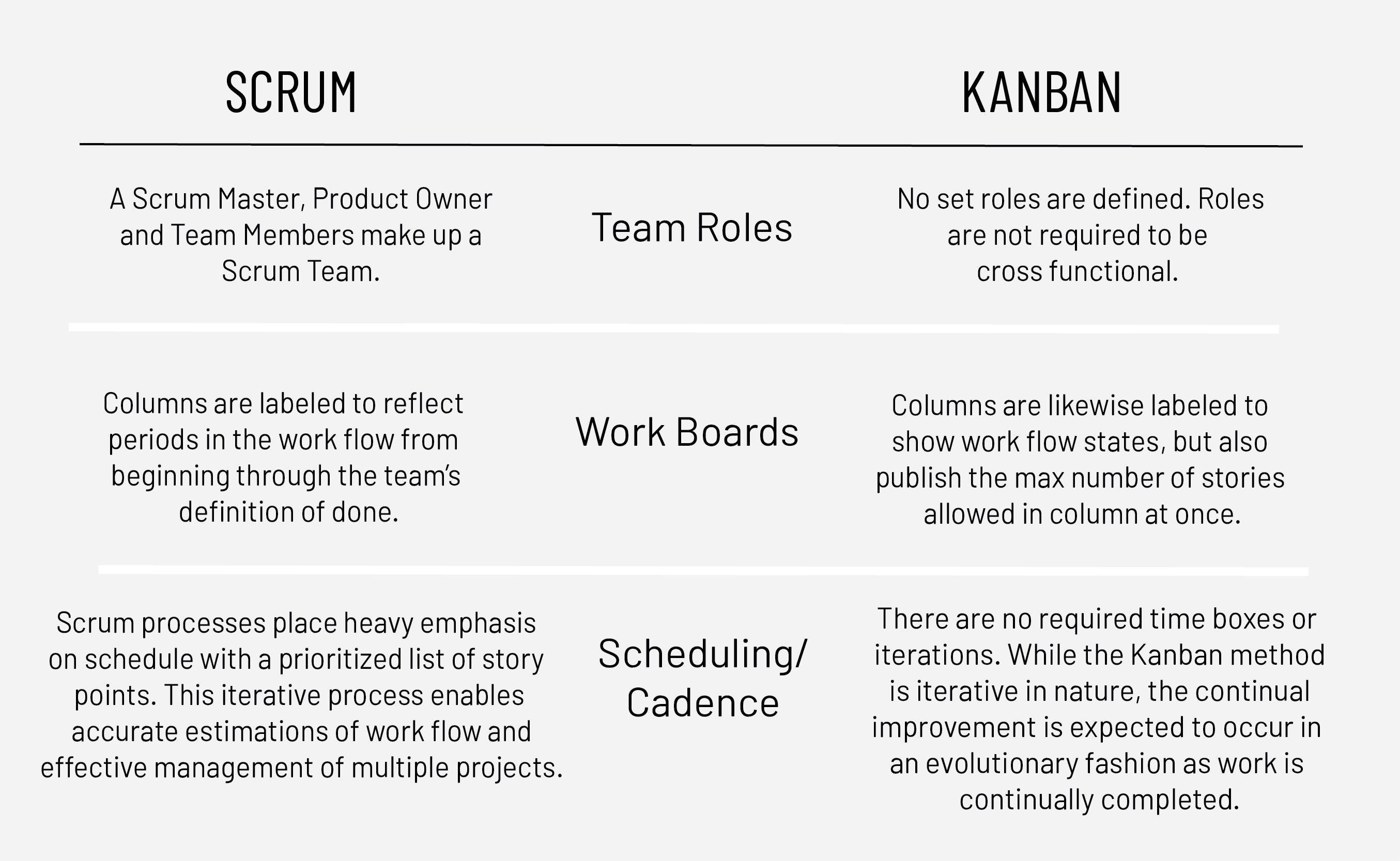
 In the table below you can find the main differences between Scrum and Kanban:


Finally the video below illustrates very clearly the differences and points out how the Scrum and Kanban boards work.


Until next time!


domingo, 19 de mayo de 2019

Project Management: Waterfall VS Agile


In today´s post we are going to focus on Project Management. More and more, we see in Supply Chain the need to step back from the operational day to day task and focus on a specific project with a clear starting and end date. However there are several methodologies that can be followed to ensure the best outcome for any given project. We will be focusing on the two most common: Waterfall and Agile.
The Waterfall method is the most traditional project management approach that uses sequential phases to define, build, test, and release project deliverables. Each phase is completed and approved before the team moves on to the next phase. The project can't move backwards to previous phases.
On the other hand, Agile is an umbrella term covering several newer project management approaches that use iterative work cycles, called sprints. Each sprint uses 'mini-phases' to define, build, test, and release the project deliverables.


The main difference between waterfall and agile methods is in the goals; the waterfall method wants to get everything right the first time, and agile methods want to get things released quickly.

Pros of the waterfall method

    - Potential issues that would have been found during development can be researched and bottomed out during the design phase.
    - The development process tends to be better documented since this methodology places greater emphasis on documentation.
    - Because the waterfall process is a linear one it is perhaps easier to understand. Often teams feel more comfortable with this approach.

Cons of the waterfall method

    - Often it´s not known exactly what it´s needed up front or what’s possible with the technology available.
    - Changes to requirements can’t easily be incorporated with the waterfall method and there are often laborious change control procedures to go through when this happens
    - The process doesn’t have its own momentum

Pros of Agile methods

    - Much more quicker, and successive iterations can be delivered frequently, at a consistent pace.
    - There is closer collaboration between project managers and the business.
    - Changes to requirements can be incorporated at any point of the process.
    - It gives the opportunity for continuous improvement for live systems.
    - It is highly transparent.

Cons of Agile methods

    - Agile methodologies are often more difficult to understand than linear, sequential ones.
    - Because of the emphasis on working software there can be a perception that documentation can sometimes be neglected.
    - When implemented badly Agile can introduce extra inefficiencies in large organizations or can be working against long standing organizational processes.

domingo, 17 de marzo de 2019

7 Characteristics of the best Demand Planners


Without a shadow of a doubt, this is one of the best articles I have read recently, and it encompasses all the key traits that make a great Demand Planner.

Difficult to pick up just a few key points, as all of them are too valuable to be left out, but here I go:

The difference between success and failure may not be dependent on intellect or even analytical ability, but on leadership skills.

They are not afraid of voicing their opinions and lead from the front, bringing solutions, not problems.

They will work on being able to express ideas or information clearly and if they do this while seeking to understand the other person’s needs and concerns.

They follow less their gut instinct and try to find a quantitative basis for an idea.

They demonstrate an interest in personal learning and development, seek feedback from multiple sources about how to improve and develop.

-  They are being able to communicate risk and uncertainty.

- They are creative in their approaches and are not afraid to try something new. They are not locked in on the way we used to do things, they do not work in a silo, they collaborate with others and finally, they are very customer-centric, focusing on adding value both internally and externally.

- They have the ability to stand strong and be wrong with confidence.  They are not afraid to take chances and learn from their setbacks and failed attempts.


http://demand-planning.com/2019/02/26/7-characteristics-of-demand-planning-rock-stars/

domingo, 27 de enero de 2019

The U.K. is filling up with a lot of Brexit stock


Short and sweet article today, a re-post of an article from the website Supply Chain Brain, that summarizes the strategy most big, medium and small size companies are taking to prepare for a no-deal Brexit.

Stocking up seems to be the only alternative to minimize potential loss sales in case a tumultuous Brexit chokes just in time supply chains and creates backlogs at ports.

https://www.supplychainbrain.com/articles/29258-the-great-brexit-stockpile-how-corporate-britain-is-bracing-for-no-deal


domingo, 16 de diciembre de 2018

Logistionary: Kaizen


Kaizen is a Japanese word that means “change ofr better” but it´s also a philosophy that refere to continuously improve; instead of encouraging large, radical changes to achieve desired goals, Kaizen philosophy recommends that organizations introduce small improvements, preferably ones that could be implemented on the same day.

In Supply Chain Kaizen is an on going process and its purpose goes beyond simple productivity improvement. It is also a process that, when done correctly, humanizes the workplace and teaches people how to eliminate waste.

While Kaizen usually delivers small improvements, the culture of continual small improvements and standardization yields large results in terms of overall improvement in productivity.
The following video, although in Spanish compliments the abobe information in an easier and approachable way!


domingo, 4 de noviembre de 2018

Persia - The Royal Road and the Silk Road


The Persian empire was established by Cyrus II, Cyrus the Great in 550 BCE with the conquest of Median, Lydian and Babylonian.

The empire kept growing and at one point around 480 BCE the Persian Empire had almost half of the whole world under its control with a population of almost 50 million of the estimated 112 million people on the whole planet.

The most notable part of Persian history include the three Persian wars that confronted the Greeks and the Persians.

It was Darius I who started the Persian wars by invading Greece mainland, and it was also him who developed the Persian Royal road, an ancient highway built to facilitate rapid communication through the Persian empire; From Susa, in Iran, to Sardis, modern-day Turkey. 2700 km in total.


Fast forward a few hundred years, the Persian Royal road served as the backbone for the most famous Silk Road, an ancient network of trade routes, both terrestrial and maritime, that connected East Asia and Southeast Asia with East Africa, West Asia and Southern Europe.

Trade on the Road played a significant role in the development of the civilizations of China, Korea, Japan, India, Iran, Afghanistan, Europe, the Horn of Africa and Arabia opening long-distance political and economic relations between the civilizations.

Though silk was the major trade item exported from China, many other goods were traded, as well as religions, philosophies, sciences, and technologies. Diseases, most notably plague and black death, also spread along the Silk Road.


As we said, the Persian Royal Road serve as one of the main arteries of the Silk Road and Iran, as a country located between China and Europe, played a key role in connecting various cultures and civilizations that existed along the Silk Road with Persepolis becaming one of the main trading points along the road.

Today, China is bringing back to life the old Silk Road with the One Belt, One Road initiative.


domingo, 23 de septiembre de 2018

All the technology you could think of in one place!

Artificial intelligence, Blockchain and Internet of Things all in one place!

This company is shaping the future by applying all these new technologies to such a simple thing as a cup of coffee.

In a world where the consumer wants to know more and are willing to pay more for those goods that are  sustainable, can be traced, are organic or from fair trade, this new company is at the fore front of innovation!


sábado, 14 de julio de 2018

Gartner 2018 top 25 Supply Chain companies


Another year Gartner has announced the list with the top 25 supply chain companies.

If you have been following this blog, you already know that this is a recurrent topic every year for us.
We already touched base on the criteria, you can find out more here, but in this post we will deep dive even more.


In 2018 Unilever came out on top for the third year in a row.
Once more Apple, Procter & Gamble, Amazon and now joining them McDonald’s were left off the formal top 25, as those four companies have been placed in a separate relatively new category called "supply chain masters," a sort of supply chain hall of fame. To get there, Gartner says a company needs to have attained top-five composite scores for at least seven out of the last 10 years.

Just three new companies made the Supply Chain Top 25 this year versus 2017, that being Novo Nordisk, Adidas and Home Depot.

Below is a chart of this year's Top 25, also with where each company placed in the last three years (NA means not in the top 25 that year).


So, you ask, how is the top 25 determined?

Gartner starts with the Fortune 500 list of top US companies by revenue and the Forbes global 2000 list that basically does the same thing on a worldwide basis. It then eliminates a lot of those companies because they do not much operate what most of us would think of as a real physical supply chain; companies in banking, insurance, software, and many more.

What's more, the minimum revenue to be included in the final evaluation list was again an amazing $12 billion.

From list, Gartner analyzes publicly available financial data, looking at three metrics:

Return on assets (ROA): Net income / total assets
Inventory turns: Cost of goods sold / inventory levels
Revenue growth: Change in revenue from prior year

ROA and revenue growth use a three-year weighted average, meaning the most recent year gets the most weight and the two prior years somewhat less. Inventory turns, smartly, uses the prior year's quarterly average (reducing impact of end of year games). These three metrics together are given a full 40% of the total score weight (20% to ROA, 10% to turns, and 10% to revenue growth).

Now keep in mind that this formula gives a tremendous advantage to some companies, such as Amazon given its huge revenue growth or McDonald's and its 175 or so inventory turns per year. It also penalizes companies like a Home Depot or a Lowes, for example, which are only going to have turns in the mid-single digits at best.

In general, this approach penalizes a company within a given sector that strategically decides on a higher service. It also gives an advantage to companies that are aggressive acquirers in terms of the revenue growth factor.

Companies that have heavily outsourced production and distribution also have an inherent advantage
because they have chosen to shed assets, and that often drives their ROA metric higher. While outsourcing can be a very smart thing for many reasons, it does not inherently improve a supply chain.

For the third year in a row, a new corporate social responsibility factor was added, which now represents 10% of the total composite score. This factor, entered in the end as a number between 1 and 10, comes from a combination of publicly available 3rd party scores on this criteria.

Another 25% of the final rankings come from so-called "peer opinion." For 2017, this consisted of about 184 apparently very influential respondents who first select a group of 25 companies from the master list of about 300 that they believe are doing the best job

The final 25% of the composite score came from votes from 42 of Gartner's own supply chain analysts.

Is the process perfect? Certainly not. The unstated assumption is, for example, that stellar financial results equals supply chain excellence. Only very, very large companies are considered. Who really knows how good most other company supply chains are? And it seems clear to me that working with Gartner and even better speaking at the Executive Conference always has a beneficial effect on a company's placement.

The Gartner top 25 supply chains - it has many faults, but it is the best we've got!
domingo, 10 de junio de 2018

Forecast bias


In this post we are going to touch on one of the most important KPIs that any demand planner should focus on: Forecast bias

Forecast bias is the general tendency for a forecast to be higher or lower than the actual value.

Forecast bias is distinct from forecast error in that a forecast can have any level of error and still be completely unbiased. For instance, even if a forecast is fifteen percent higher than the actual value half of the time and fifteen percent lower than the actual value the other half of the time it has no bias. If the forecast is on average fifteen percent higher than the actual value has both fifteen percent error and fifteen percent bias.

Bias can exist in statistical forecasting or in judgment methods. With statistical methods, the forecasting model must be adjusted or switched to a different model. For judgment methods however, bias can be conscious and driven by certain incentives provided to the forecaster or it can be unconscious.

How to simply calculate forecast bias at an aggregated level?

BIAS = Historical Forecast Units minus Actual Demand Units.

The impact of bias can mean that either an organization is holding too much inventory (over-forecast bias) or missing sales due to service issues (under-forecast bias).


domingo, 13 de mayo de 2018

The Internet of Things


A lot has been written already about the Internet of Things (IoT) and how it will affect nearly every business and industry; In my opinion, one of the most exciting areas of impact and disruption is the global Supply Chain.

One great example to illustrate this is this short clip from the TV show Portlandia, in this episode, two friends are dinning out and before ordering they insist on knowing as much as possible about the chicken they will be eating. They find out his name, what he was fed, his social habits etc. The process of assessing the chicken before agreeing to eat it might be a bit too bizarre, but with the IoT, this will become the norm. We will be able to experiment that type of transparency, and eventually it will be demanded by suppliers, customers and end consumers.


Among many other, some of the benefits that the IoT will bring are:

- Operational efficiency: The real-time visibility derived from the IoT enables information to be shared at every level allowing deficiencies to be identified quickly so that problems can be immediately rectified, or possibly even prevented altogether. Companies can see delays, slowdowns or trends that will affect the bottom line and inefficient processes that are costing them money can be identified and corrected

- Customer services: The IoT will dramatically reduce the amount of time from click to fulfillment. With customers demanding more and more information the IoT will fulfill up to the minute details on where their item is in transit and accurate alerts notifying them of delivery dates and times.

- Inventory management: The IoT will allow organizations to automatically know when products must be restocked or reordered, eliminating delays or inventory issues that would send customers to the competition.

Linked to this, loss management will greatly improve: with sensors tracking every movement, it will be almost impossible for merchandise to simply “disappear”, and if it does, it will be possible to know exactly where the incident happened and what factors may have contributed to merchandise loss.

Asset Tracking and in transit visibility: New RFID (we talked about RFID technology here) and GPS sensors can track products “from floor to store” and even beyond. At any point in time, manufacturers can use these sensors to gain granular data like the temperature at which an item was stored, how long it spent in cargo, and even how long it took to fly off the shelf.


With some many possibilities, challenges will also need to be considered:


- Need of many different technical elements to deploy the end-to-end IoT solutions: Network infrastructure, devices, applications, platforms, security solutions, and integration services.

- Security: All the information must be prevented from falling into the wrong hands, or hacked. Sensors should only send specific information, which must be held in a secure, private cloud environment. Here is where Blockchain technology (see more about Blockchain here) will play a definitive role.

Overall, with everything becoming much more internet-driven, IoT in the supply chain is still only in its infancy, but sure to take off, exciting times lie ahead!